
One job, one employer, one career until retirement – for a long time this was the template for a “proper” career. For a growing number of people it no longer fits their own reality, or a working world that keeps changing.
A portfolio career combines several roles, skills and often several income streams into one coherent whole. It is not an accidental pile of side gigs; it is a deliberately designed professional identity.
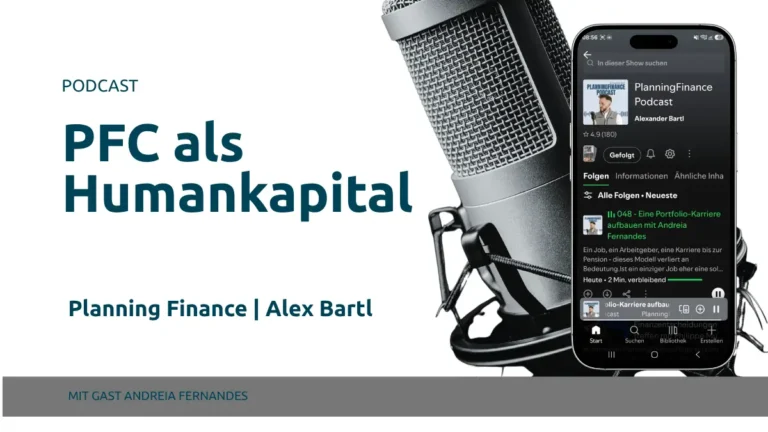
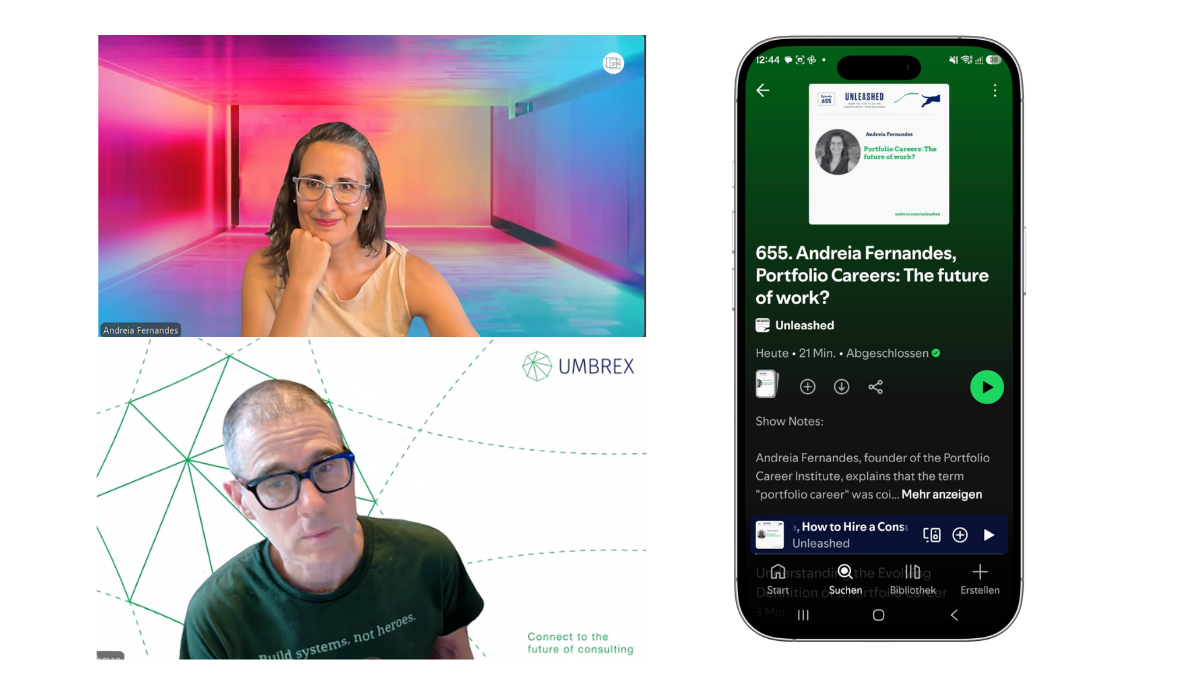
On the Unleashed podcast by Umbrex, Andreia Fernandes – founder of the Portfolio Career Institute (PFCI), executive coach, university lecturer and keynote speaker – talks with host Will Bachman about what a portfolio career really is, why it is becoming more relevant, and how to design one step by step.
The term goes back to management thinker Charles Handy, who raised it in the 1990s to describe people who work in different roles. Andreia builds on that idea and adds a matrix: you can expand a portfolio career by taking the same skill into a new context, or by bringing a new skill into your work. A mathematician might work at a school and, part-time, for an insurance company – or be a mathematician and a yoga instructor.
One point is easy to miss: a portfolio career is not only about diversifying income, even if that matters more and more. It is anchored in your values. That is what turns a multi-passionate professional from someone who is merely busy into someone with a coherent career.
It’s really also aligning with one’s values, so it’s really purpose driven. I think that’s the most important part.
Andreia Fernandes
In the cohort, the work does not start by collecting roles, but with clarity: What are my strengths? What is my purpose and vision? Where are my limits, and where do I need help early on? That includes an honest evaluation of whether a portfolio career is even the right path. Andreia deliberately challenges people who mainly want to escape a corporate environment, because in that case a role at a small or mid-sized company might serve them far better.
Her framing is refreshingly unsalesy: if you conclude a portfolio career is not for you, you still design your future together – just without the portfolio component. From there it becomes life design: exploring through iterations rather than committing to a fixed plan.
She likes one example of testing before committing: a woman was convinced her ideal life included running a small Airbnb finca on Mallorca. Instead of selling everything and moving, she booked herself into different fincas across a summer – and week after week noticed how repetitive the hosting actually was. What she truly wanted was simply to host people, so she came home and started hosting dinners instead. It is the same logic as Anne-Laure Le Cunff’s book Tiny Experiments: run small, low-stakes tests, and expect that nine out of ten things you try will not stick.
Two tools anchor the reflection. The first is the Japanese Ikigai principle – what you love, what the world needs, and how you can make a living from it. As one participant put it, Ikigai and portfolio careers go hand in hand, because both start from impact and meaning.
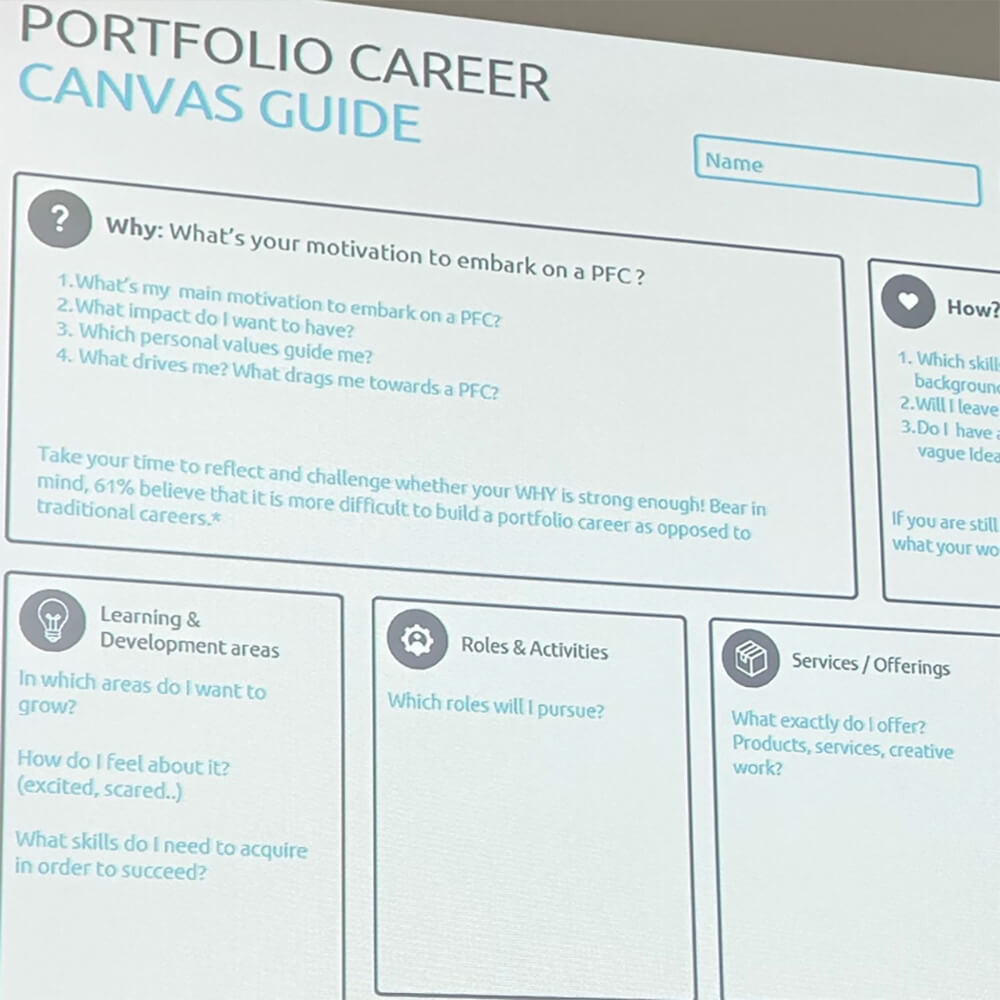
The second is the Portfolio Career Canvas, a framework Andreia developed on a scientific foundation – important to her because, in Switzerland as in the US, “coach” is not a protected title. Like a business model canvas, it starts with your why, then moves through your portfolio metrics (are you expanding into new contexts or with new skills?), your learning journey, your network, and your revenue streams. The pivotal question it forces you to answer: what would make me regret having built a portfolio career?
Once you start designing and running small experiments, activating your network becomes essential: who can help, and where are the low-hanging fruit? Then comes positioning. If you do three or four different things, what is your clear value, and what distinguishes you from others?
Andreia speaks from more than a decade of her own portfolio career – as an entrepreneur (including ventures that failed), a lecturer in entrepreneurship at the University of Zurich, and an executive coach. Her own USP, as she describes it, is connecting the dots between strategy and leadership: helping B2B clients with global collaboration, running quarterly sparring sessions with executives, and leading entrepreneurship boot camps. The strands reinforce one another and build genuine career resilience.
The programme runs as a cohort, and the exchange with others carries the process. Andreia describes two risk specialists from banking who took opposite paths – one built her portfolio around banking, the other wanted out entirely – and could learn from each other precisely because of that difference. The first realisation the cohort creates is simple but powerful: you are not alone in this, so start doing it together.
A common worry is that diversifying makes you look less credible as an expert. Andreia counters this with research on so-called multiple jobholders – today often described as fractional talent – which catalogues a wide range of real-life personas across very different professions, from the musician who also teaches maths to the writer who also helps others write. She features a different one of these personas on the Portfolio Career Institute’s channels every Sunday, precisely to show that a portfolio career does not depend on your profession.
Some of the patterns she sees:
Each activity allows you to relax from the other activity, so it gives you new energy for the tasks you do.
Andreia Fernandes
One cohort example: a banker who looked beyond risk management, began teaching in executive education, and then discovered she also wanted to manage projects – now leading an international development project. Another strengthened her existing company by testing several business models and expanding her product portfolio from within. The common thread: there is no limit to what a portfolio career can look like. What counts is that it fits the person and is designed on purpose – a form of career reinvention that builds in flexibility and a real work-life blend rather than leaving them to chance.
Thinking about building your career more deliberately and on a broader base? In the Portfolio Career Programme (PFC), Andreia Fernandes guides you and a cohort step by step – from taking stock, through the Portfolio Career Canvas, to positioning yourself in the market. The next cohort starts in autumn, with a new one each spring and fall.
Prefer to talk first? Get in touch.
Unleashed is produced by Umbrex, whose mission is to connect independent management consultants with one another, creating opportunities to meet, build relationships and share lessons learned.
LinkedIn – Andreia Fernandes
LinkedIn – PFCI
Instagram – Andreia Fernandes
Instagram – PFCI
The examples in this article come from Andreia Fernandes’ coaching practice and are shared in anonymised, generalised form. The pull quotes are taken verbatim from the episode transcript. The framing of the term “portfolio career” follows the work of Charles Handy (1990s); the exact first use is dated inconsistently across the literature.