
“Sounds great, but not in my industry.” “Not with my education.” “Not at my age.” Let’s test those assumptions against 48 real portfolio careerists.
Whenever I talk about portfolio careers, one question comes up within minutes:
“Sounds interesting, but in MY industry that’s not gonna work.”
For me – in my industry, with my degree, at my stage of life … you name it.
It’s an honest question – whether you call the model a portfolio career, a slash career or a fractional career. And the honest answer is: it is deeply individual. There is no industry test, no diploma requirement, no age limit that decides it for you. What the research shows instead is far more interesting – and far more encouraging.
What 48 real portfolio careerists reveal
One of the most in-depth studies on this topic followed 48 people who each held two to eight work roles at the same time (Caza, Moss & Vough, 2018, published in Administrative Science Quarterly). The people you will meet below are real study participants – the names are pseudonyms used by the researchers.
Here is what that group looked like:
- Ages 25 to 63
- Education from high school diploma to MBA, JD, MD and PhD
- Single, married, divorced; with zero to four children
- Industries from medicine and law to music, real estate, tech and retail
Read that list again. There is no “portfolio career type.” There are only individual combinations.

Six real combinations – six different logics
Amy (31) keeps a corporate anchor as a senior project administrator – and co-owns a bar and a software company on the side. Employment and entrepreneurship are not opposites; for many multiple jobholders they stabilize each other. We’ve previously introduced her here and here.
Byron (42) trained at a technical college. He works as an electronics integration specialist, manages properties and owns a franchise. No university degree – a robust, income-diversified portfolio built on hands-on expertise. Career resilience in practice. Learn more about him here or here.

Brenda (39) is a naturopathic physician – a regulated profession. She adds medical writing, blogging, life coaching and organizing a women’s conference. Even in licensed fields, the portfolio logic works: one core expertise, several expressions.
Ed (35) is a senior manager for copyright royalties by day – and a guitarist and label manager beyond that. His portfolio is how he keeps his musician identity alive without giving up professional stability.

Gary (57) combines being a musician, children’s songwriter, restaurant singer, novelist and painter. A reminder that portfolio careers are not a young person’s game – the study’s participants reached into their sixties.
Gemma (48) sits on several boards, consults for small and medium enterprises, writes and mentors. Her portfolio is a classic later-career reinvention – essentially a fractional career: converting decades of experience into several part-time, high-value roles.

So if it’s not industry, degree or age – what is it?
A large research review across more than 180 studies (Campion, Caza & Moss, 2020, Journal of Management) points to a different set of factors. Whether holding multiple jobs depletes you or enriches you depends less on what field you are in and more on:
Why you are doing it. People pushed into multiple jobs purely by financial pressure report more exhaustion. People pulled by growth, meaning or unexpressed sides of themselves report more energy and satisfaction. Both motives can coexist – but which one dominates matters.
How much control you have. Autonomy over your schedule and your clients is one of the strongest buffers against overload.
How you manage the roles. Successful portfolio careerists in the study developed concrete practices – from strictly separating their roles to, over time, finding one theme that connects them. Greg, an adjunct professor who also runs a nutrition coaching company, speaks and coaches an Olympic team, described exactly this shift: from juggling separate jobs to seeing one coherent professional self.

Your time horizon. Those who see their portfolio as a long-term way of working – not a temporary fix – invest in sustainable routines and benefit more.
And that’s what we focus on with our Portfolio Career Programme!
Four questions instead of one
So instead of asking “Is a portfolio career possible in my industry?”, try these four questions for career clarity:
- What pulls me? Is there a skill, identity or interest that my current single job leaves unexpressed?
We look at the so-called Portfolio Careers Matrix, whereby you can expand your career to a portfolio through either adding new fields with new skills or existing skills in a new context. - What is my anchor? Which role gives me stability – financially or psychologically – while I build the rest?
- How much control do I realistically have over my time and my work-life blend, and where could I create more?
- Am I willing to manage this actively? A portfolio career is not passive variety; it is deliberate role design.
If these questions spark something, that is your signal to explore further – not a guarantee, but an invitation to consider a career transition on your own terms.
A note on honesty
Portfolio careers are not for everyone, and the research is clear that they can deplete as well as enrich. The study behind these personas drew on a specific, largely US-based sample; how the patterns translate to every labour market – including here in Europe – is still an open research question. What is well documented: the people who thrive did not fit one profile. They asked themselves the question.
Maybe it is your turn to ask it.
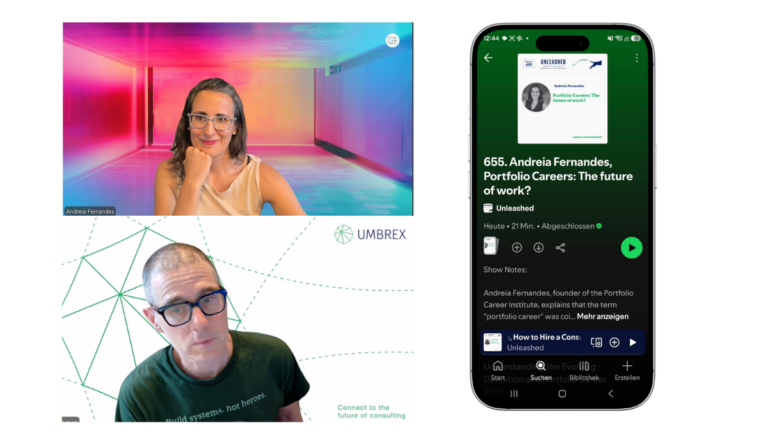
If you would like to hear more, check out the latest podcast episode where Andreia was a guest – and if you prefer watching, here are some of our webinars.
Already asked yourself these four questions – and the PFC® programme feels like your logical next step? Then reach out to Andreia directly. She is happy to answer whatever is still open.
Sources
Caza, B. B., Moss, S., & Vough, H. (2018). From synchronizing to harmonizing: The process of authenticating multiple work identities. Administrative Science Quarterly, 63(4), 703–745.
Campion, E. D., Caza, B. B., & Moss, S. (2020). Multiple jobholding: An integrative systematic review and future research agenda. Journal of Management, 46(1), 165–191.
All persona names are pseudonyms from the original study. Role combinations are as self-reported by participants; visualized proportions are illustrative.