
⭐ Start your Portfolio Career – Join the 2026 Fall Programme. ⭐ Learn more →
Have you noticed what’s quietly happening to the jobs society used to consider “lower-level”?
For decades, the hierarchy seemed clear: manual, physical, blue-collar work sat at the bottom. Intellectual work – analysis, writing, strategy, coordination – was where the value was. Where the status was. Where the future was supposed to be.
AI is inverting that logic. Fast.
The cognitive layer is being automated
Tasks that defined high-status knowledge work are precisely the ones AI handles best:
These are not single use cases – they are becoming the daily reality of lawyers, consultants, financial analysts, middle managers, and junior roles across entire industries.
This doesn’t mean those professions will disappear. But it does mean the intellectual tasks that once justified their status and their salaries are increasingly being absorbed by machines.
And the anxiety is real and well-documented.
One of the most discussed shifts right now is the disappearance of entry-level positions in consulting, finance, and law: precisely the roles that used to serve as the gateway into professional careers. The junior analyst who spent hours building slide decks, summarizing research, or drafting first versions of contracts? That work is now largely automatable.
As Harvard Business Review noted in October 2025, professional services firms have long relied on a simple talent strategy: hire large numbers of capable young associates to do the heavy lifting, freeing up partners and senior staff to sell new work and set strategy with only one or two of every hundred associates ever reaching partnership. AI is now dismantling the economic logic of that model. Harvard Business Review
What remains unclear is whether those entry points will be redesigned — or simply removed. Writing for Handelsblatt, Deloitte’s Chief AI Officer put it plainly: many of the classic tasks for new entrants – research, analysis, data preparation – are increasingly being handled by AI and specialized agents. The deeper question this raises, he argues, is where tomorrow’s experts will actually come from, once those traditional entry paths disappear. Handelsblatt
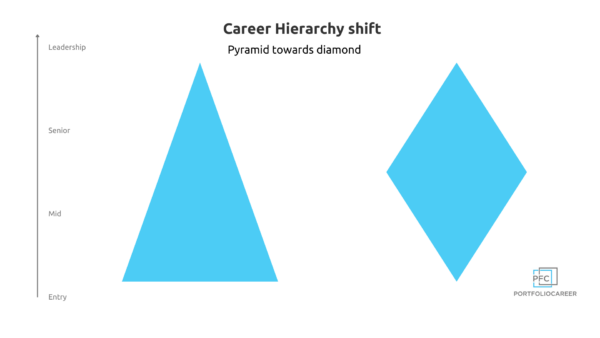
But the disruption does not stop at the bottom of the ladder. The ladder itself is changing shape. For decades it looked like a pyramid – broad at the base, narrow at the top. That classical model, organized as a pyramid with a wide base of juniors carrying out manual analysis, is now facing fundamental change, according to Handelsblatt. The real structural question is how expertise will be built and passed on in an AI-driven world. The career ladder is increasingly resembling a diamond: hollowed out in the middle, with pressure applied from both ends simultaneously.
And even the top is not immune. According to Gartner, by 2026, 20% of organisations will leverage AI to eliminate more than half of their current middle management roles. A 2025 Korn Ferry survey found that 41% of employees already report their companies have reduced managerial layers. The partner track, long seen as the pinnacle of knowledge-work ambition, is being fundamentally rethought across the industry- with HBR dedicating two separate analyses to the structural reshaping of consulting firms in autumn 2025 alone (“AI Is Changing the Structure of Consulting Firms”, September 2025; “How AI Is Upending How Consulting Firms Hire Talent”, October 2025). goodreads
For a generation that invested heavily in degrees and credentials to access these roles, this is not an abstract concern. It is a structural shift in how professional careers are built – and it raises urgent questions about where the next generation of senior talent will actually come from, if the apprenticeship layer beneath them disappears.
The physical layer cannot be automated – not yet, and not easily
Meanwhile, the person fixing your heating system, installing your solar panels, caring for your elderly parent, or maintaining the infrastructure your digital economy runs on? Still there. Still needed. Increasingly hard to find.
And crucially: these roles are not staying the same. They are absorbing complexity that used to sit elsewhere. An electrician today works with smart building systems and digital diagnostics. A care worker navigates AI-assisted monitoring and makes judgement calls no algorithm can make for them. A technician reads predictive maintenance data and acts on it with their hands.
The manual work is still manual. But the qualification required to do it well has risen substantially – precisely because the cognitive scaffolding around it has been automated away, leaving only the parts that require a human being who is physically present, contextually aware, and technically capable.
Yes, humanoid robots are entering the picture – and in specific, controlled environments they already make sense. But the idea that they will take over the full breadth of human physical work, in all its situational unpredictability, remains far off. I wouldn’t bet a career strategy on it.
We built an entire prestige system on the wrong assumption
We told a generation that the path to success ran through a university degree, a desk, and a screen. Vocational training was, in most countries, what you did if academia didn’t work out. Blue-collar work was something to be moved away from, not toward.
Having grown up in Switzerland, I have always appreciated that many trades still carry genuine prestige here – because it is clear that the person spent three or four years actually learning a craft, from both a practical and a theoretical perspective. The vocational education system is something I value deeply. It was also where my own career began – with a commercial apprenticeship – long before I knew it would become a career at all. It was my first real step into professional life, and the foundation from which I eventually went on to university when I realised my ambitions were pulling me further.
Yet even in Switzerland, blue-collar work has often been something people tried to move away from, not toward. That narrative is now colliding with reality. The roles we automated our way toward are under pressure. The roles we automated our way away from are in shortage – and in many cases, quietly becoming more sophisticated, better compensated, and more resilient than what replaced them at the top of the old hierarchy.
This is what we call the Doorman Fallacy.
The doorman at a hotel has no degree on his wall. No laptop. No Zoom calls. And yet he reads social dynamics in real time, manages unexpected situations with composure, and operates in a physical world that no large language model can navigate without a body. Society looks at him and thinks: low skill, low value, easily replaced. Wrong on all three counts.
This reflection touches something personal. Having grown up in a working-class family and worked my way up through Switzerland’s system has been both a blessing and a steep learning curve. Today I navigate both sides – I find just as much meaning in mandates within the construction industry as in projects with Big Four companies. In either context, I know which language to speak, which questions matter, and where the real complexity lives. That range didn’t come from a single credential. It came from a portfolio of experiences.
And sometimes, in my programmes, I hear from participants who left the corporate world not because they were pushed out – but because they were tired. Tired of status games. Tired of performing a version of professionalism that felt hollow. That impulse is always worth examining: what are we actually chasing, and why?
The Doorman Fallacy is the tendency to confuse status with resilience – to assume that because a job lacks prestige, it lacks a future. AI is making that assumption increasingly expensive to hold.
So what does this mean for you?
The next wave of valuable work is not coming for those who can delegate the most to machines. It is coming for those who show up – physically, presently, capably – where machines cannot go.
We don’t have all the answers yet. But we do know this: diversifying across skills, sectors, and ways of working – in line with your own talents and preferences – is one of the most robust strategies for staying relevant. That is, in essence, what a portfolio career is about.
Your career is your most strategic asset. Are you treating it that way?
The rules of professional life are being rewritten faster than most people realise. The jobs that seemed safe are under pressure. The jobs that seemed beneath consideration are gaining value. And the professionals who will navigate this best are not those with the most impressive single credential but those who have built range, adaptability, and a career that doesn’t depend on one role, one industry, or one skill set.
That is the core idea behind a portfolio career.
If this piece made you think differently about your own path – about what you’ve discounted, what you’ve assumed, or what you haven’t yet explored – that reflection is worth taking seriously.
At the Portfolio Career Institute, we help professionals build careers that are resilient by design: across sectors, across skills, and across the changes none of us can fully predict.
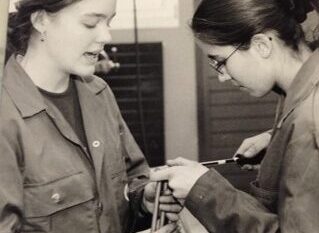
Fun fact: the picture of this blog is me 1999 building a Lamp that is my desktop lamp until today – I wrote about it here
Please enter your details to download this resource.
Join a community of curious professionals exploring portfolio careers, personal leadership, and a more flexible future of work. Get tools, inspiration, and insights straight to your inbox.